
On this page
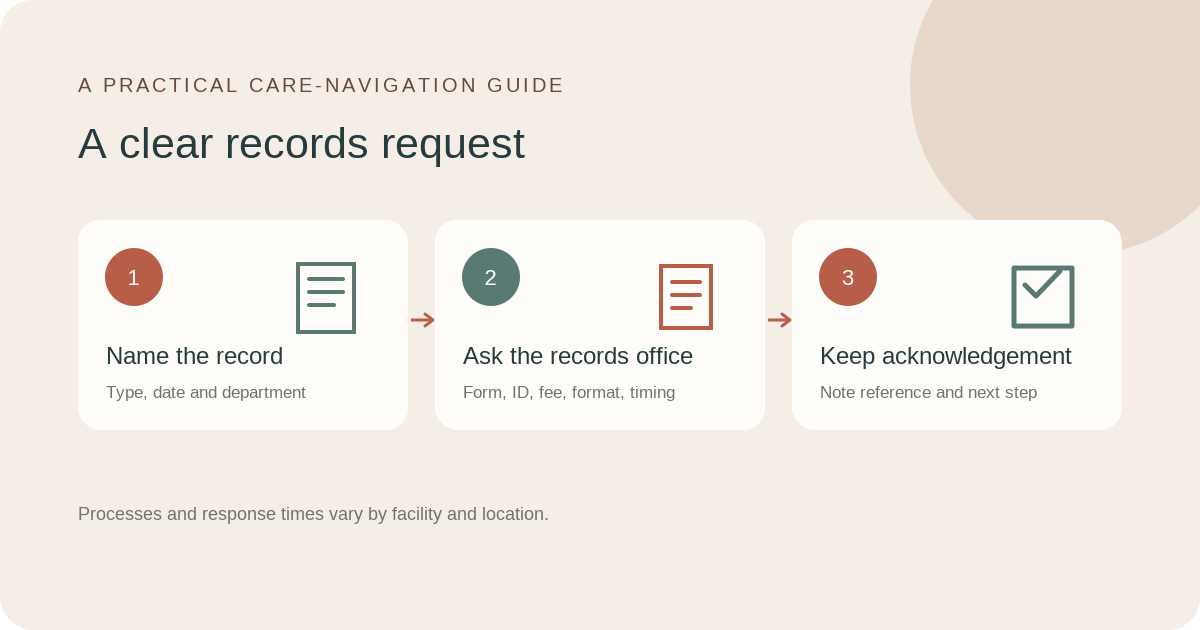
If you need a copy of a scan report, discharge summary, prescription or operation note, the first step is usually to ask the hospital that holds the record how it handles requests. You can make the request more useful by naming the document, date or admission, department and preferred format. Keep a copy of what you sent and note how to follow up.
This guide explains a practical request process. It does not give legal advice or guarantee that every record will be available in a particular format or by a particular date. The Ministry of Health and Family Welfare’s Patients’ Rights Charter includes access to copies of case papers, inpatient records, investigation reports and a detailed bill. However, the Ministry has stated that state and union territory governments adopt, implement and monitor the Charter, including within the applicable Clinical Establishments Act framework. The process, charges, identity checks, record-retention practices and response times can therefore differ between facilities and locations.
Decide which documents you need
“My medical records” can refer to many documents created during different visits. A focused request helps the medical records department locate what you mean. Before contacting the hospital, list the document types and approximate dates. Examples may include:
- Discharge summary for a specific admission
- Operation note or procedure record
- Laboratory, pathology or imaging reports
- Outpatient consultation notes or case papers
- Medication or prescription record
- Referral letter, consent form or itemised bill
The 2021 Ministry charter’s records section refers to originals or copies of case papers, indoor patient records and investigation reports. It also refers to the right to an itemised bill and an explanation of charges. A hospital may use its own name for a document, so describe its purpose if you are not sure of the formal title. For example, explain that you need the note recording what happened during a past operation, rather than guessing the form name.
If your purpose is an upcoming consultation, ask the receiving practitioner which records would be helpful. A small, relevant set may be easier to locate than a large file. If you are unsure whether a particular record exists, ask the hospital what records from the visit it holds.
Find the right department or contact
Look for a Medical Records Department, Health Information Management Department, records counter or patient-support desk. If the website does not list a contact, call the facility’s official enquiry number and ask which office accepts requests. The outpatient clinic or inpatient administration may direct you to the correct desk.
Ask how requests can be submitted: in person, by email, through a patient portal or by post. Confirm whether it needs a signed form, identity documents, patient number, admission dates or a fee. Do not send sensitive documents to an unverified email address or personal messaging number.
Government hospitals may publish their own process. For example, the Ministry’s Central Bureau of Health Intelligence page for Dr Ram Manohar Lohia Hospital in New Delhi describes its Medical Records Department and says that records are private and confidential. It also states that the hospital issues records to the patient or, in specified circumstances, a legally authorised heir or representative. This is that hospital’s process; do not assume another government or private facility uses the same forms, retention period or eligibility checks.
What to include in a request
Make the request specific and easy to route. Include your full name as registered at the time of care, date of birth if requested, current contact details, hospital or patient ID, department, and the approximate visit or admission date. Give a short, itemised list of the records you are requesting. If the hospital has multiple campuses, identify the one where you were seen.
You can also state how you would like to receive the records, such as a paper copy collected at the hospital or an electronic copy if the facility offers that option. Ask whether there is a copying or retrieval fee and how to pay it. Do not assume copies are always free or that electronic delivery is available. The Ministry charter describes photocopy costs as potentially applicable wherever relevant.
If a representative will submit or collect records for you, ask what authorisation the hospital requires before sending them. A facility may ask for a signed authorisation, proof of identity for both people or other documents. Requirements may differ, especially for a minor, a patient unable to make the request, a deceased patient or a legal representative. Do not rely on a general online template as proof of eligibility. Confirm the specific facility’s current process.
Here is a concise structure you can adapt:
Keep the wording factual. You do not need to include a detailed health history in the request unless the hospital says it needs that information to identify the record. If the request is for an appointment elsewhere, you may mention that the documents are needed for continuity of care, but avoid sending more personal information than necessary.
Ask for an acknowledgement and next step
When you submit the request, ask for an acknowledgement, reference number, receipt or the name of the office that received it. Confirm what happens next: whether the hospital will contact you, whether you need to collect the documents, and what to do if the record cannot be found. If you are told to return later, note the date and contact method. If you make the request by email, save the sent message and any reply. If you submit a paper form, keep a copy or photograph of it where the facility permits.
The Ministry’s 2021 charter supports access to records and reports, but it does not mean that every hospital has an identical workflow or that a single national turnaround time applies in every situation. The older NHRC-recommended charter used preferred timeframes for some records. Do not treat those preferred timeframes as a guaranteed statutory deadline without checking current rules and how they apply to the facility. If timing matters for an upcoming appointment, tell the records office the date and ask whether any documents can be provided sooner or whether the clinician can request them directly.
If the response is delayed, follow up with your reference number and the date you first submitted the request. Ask whether the request is complete, whether additional identification or payment is needed, and which documents have been located. If only some records are ready, ask whether those can be provided while the rest are being searched. Keep a calm, dated record of each contact. This can make escalation clearer if you need it.
If the request is refused, incomplete or difficult
Ask the hospital to explain the reason and next step, such as a missing form, identity document, authorisation or corrected date. For a partial response, compare the documents with your list and ask which items remain missing and which department holds them. Keep the reply and reference number.
If follow-up does not resolve the issue, ask for the facility’s patient-relations or grievance process. The NHRC-recommended Charter and SGMH Delhi hospital rights page describe grievance mechanisms, but the appropriate route depends on location and facility. For a rights dispute, seek qualified local advice.
Can ABHA help you find the records?
Ayushman Bharat Health Account (ABHA) and Personal Health Record applications can support digital access to or sharing of records linked through participating systems. The Government says healthcare providers hold records and ABDM facilitates consent-driven exchange; it does not store every person’s full medical record centrally. Private providers may choose whether to participate.
An ABHA account is not a guarantee that every older visit, paper file, scan or operation note will appear online. You may still need to contact the facility that holds the record. Check the official ABHA/ABDM app and facility participation details before relying on a digital route.
If you use a digital route, read what you are authorising before sharing records with another provider. Confirm which records are being shared and with whom. This article does not imply that a digital health ID is required to make a paper request.
Before you submit
Use this short checklist:
- Name each document and the visit or admission date as closely as you can.
- Confirm which department accepts the request and what form it uses.
- Ask about identity checks, representative authorisation, fees and formats.
- Use an official facility contact and share only necessary personal information.
- Request an acknowledgement or reference number.
- Note how and when to follow up, without assuming a universal deadline.
- If records are for a consultation, ask the receiving practitioner what is useful.
If you are preparing for another appointment, our guide to organising existing health records can help you sort documents you already have. Our health-record clarification sheet is for asking a practitioner about wording in a record; it does not replace the hospital’s copy-request process. If records relate to a past hysterectomy, see our guide to checking an operation record.
Frequently asked questions
Which hospital department should I contact for copies of records?
Ask the facility’s switchboard or patient-support desk for its Medical Records Department or equivalent. Names and workflows vary, so confirm which office handles your specific visit or admission.
What details help a hospital locate my records?
Provide the name used during care, approximate date, department, campus and patient or registration number if known. List the document types you need rather than requesting an undefined complete file.
Is there one deadline for every Indian hospital to provide records?
This guide cannot promise a single deadline. The Ministry says state and union territory governments implement the Patients’ Rights Charter within their remit. Ask the facility about its current process and timing.
Can a family member collect my medical records?
Do not assume relationship alone is enough. Ask the facility what signed authorisation, identity documents or legal authority it requires for another person to submit or collect records.
Will all my medical records be available in the ABHA app?
No such guarantee is made here. The Government says providers hold records and ABDM facilitates consent-based exchange. Older or unlinked records may still need a direct request to the facility.
What should I do if some requested documents are missing?
Ask the records office which items were found, whether another department holds the rest and what further details could help the search. Keep the written response and your request reference.
Should I pay a fee before asking for records?
First ask the facility whether a fee applies, how it is calculated and how payment is accepted. The Ministry charter notes that photocopy fees may apply where relevant, while local procedures differ.
What if the hospital does not respond to my follow-up?
Ask for its patient-relations or grievance process and include your acknowledgement number and dated follow-ups. The suitable escalation route depends on the facility, location and circumstances.
Sources and further reading
- Ministry of Health and Family Welfare, Charter of Patients’ Rights and Responsibilities, updated 23 August 2021
- National Human Rights Commission, Charter of Patients’ Rights, 2019
- Press Information Bureau, Ministry of Health and Family Welfare, Charter of Patients’ Rights, 11 February 2022
- Sanjay Gandhi Memorial Hospital, Government of NCT of Delhi, Patient’s Rights
- Central Bureau of Health Intelligence, Ministry of Health and Family Welfare, Medical Records Department, Dr Ram Manohar Lohia Hospital
- Press Information Bureau, Ministry of Health and Family Welfare, Explainer on Ayushman Bharat Health Accounts (ABHA), 4 April 2024
This resource provides general information and does not diagnose a condition or replace advice from a qualified practitioner.