
On this page
Seeing a cholesterol report with several numbers and flags can make it hard to know where to look first. The names are similar, the units may differ between laboratories, and one result rarely answers every question about heart health.
This guide explains common lipid-panel terms and offers questions to ask the clinician who requested the test. It does not calculate your cardiovascular risk, diagnose a condition or set a treatment target for you. Reference ranges and care decisions depend on the full clinical picture and the laboratory method.
Start with the report, not a colour or flag
Check that the report belongs to you and note the collection date, the laboratory, the units and whether the report says you were fasting. Keep the full page, including its reference intervals and any comments. If you have an earlier report, bring both rather than comparing only one number from memory.
Laboratories may show results in different units, commonly mg/dL or mmol/L. Do not compare values until you have checked the units. A number printed in one unit cannot be read as if it were in another. If the report is hard to read, ask the laboratory or the clinician's office to explain which units and reference interval apply.
A bold value, colour band or asterisk is a laboratory prompt to review the result against that lab's range. It is not a diagnosis by itself. Likewise, a value inside a reference interval does not automatically answer whether a person with particular health conditions or history needs follow-up. Ask the clinician how the report should be understood in context.
What a lipid profile commonly measures
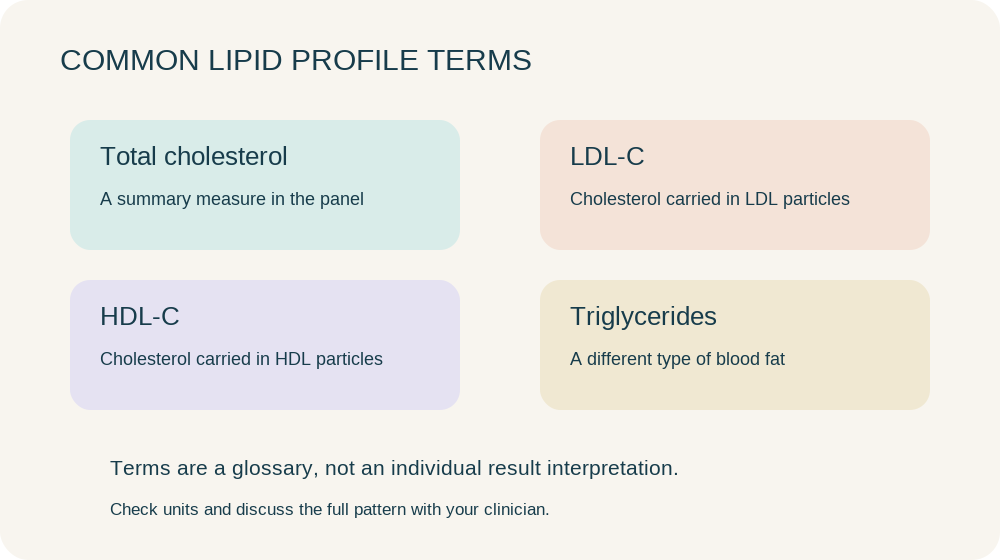
A lipid profile, sometimes called a lipid panel, usually includes total cholesterol, LDL cholesterol, HDL cholesterol and triglycerides. The report may also display non-HDL cholesterol or calculated values. The exact panel and calculation can vary. Ask what was measured directly and what was calculated if that distinction matters to your clinician.
Total cholesterol is a summary measure of cholesterol carried in different particles. It does not show the whole pattern by itself. Two reports with similar total cholesterol can have different component values, so the clinician generally looks at the panel rather than treating total cholesterol as the only meaningful number.
LDL-C means cholesterol carried in low-density lipoproteins. Public health material often uses “bad cholesterol” as a shorthand because higher LDL-C is associated with cardiovascular risk. The phrase is incomplete, though: it does not tell you what your individual risk is, and it is not a stand-alone diagnosis. The result is considered alongside other information.
HDL-C means cholesterol carried in high-density lipoproteins. It is sometimes called “good cholesterol,” but that nickname can mislead. It does not mean that a higher HDL-C cancels every concern about other results, nor does it establish that someone is protected. Researchers studying women through midlife have found that HDL measures can change around the menopausal transition. Those group-level findings cannot tell an individual what caused a result or what action is needed.
Triglycerides are another type of fat measured in blood. They are not the same thing as cholesterol. The report may show them in the same panel, but the clinician will interpret the value with the rest of the results, the reason for testing and relevant health information.
Non-HDL cholesterol, when shown, is generally total cholesterol minus HDL-C. It represents cholesterol in the other measured lipoprotein fractions and can be useful as part of an assessment. It is not a replacement for a clinician's evaluation or a personal risk calculation on this page.
Why the full pattern and personal context matter
The clinician may consider age, blood pressure, smoking, diabetes, kidney or other health conditions, medicines, family history and previous cardiovascular events. These examples are not a checklist for self-scoring. They show why an isolated lipid number cannot provide a complete answer. A practitioner may use a locally appropriate risk tool or other clinical guidance; any tool has limits and needs accurate information.
Midlife is a period when several things can change at once. Observational research has reported changes in some lipid measures across the menopausal transition, but an association over time does not prove that menopause caused a particular person's results. Age, inherited factors, health conditions, medicines and other life circumstances may also be relevant. A lipid report cannot diagnose perimenopause or menopause, and menopausal stage cannot by itself explain a flagged result.
Research findings also depend on who was studied and which measure was examined. The SWAN study followed a defined cohort of women and examined HDL-related measures around the final menstrual period. It offers population evidence, not a prediction for every woman in India. Another study may report trajectories in a different group or use different measures. Do not convert a cohort average into an individual forecast.
If your result changed from a previous report, ask whether the tests used the same laboratory method, units and fasting conditions. Ask if the change is large enough to affect the next step, or whether your clinician wants another test. Do not assume a small difference is a trend or that a single comparison explains why it changed.
Fasting and preparation questions
Some lipid tests may be requested with fasting, while in other situations a non-fasting sample can be used. Follow the instructions from the person who ordered the test and the laboratory. If you were not told whether to fast, call before the next collection and ask what to do. Do not repeat a test or change food, medicine or supplement use based on a general article.
Tell the clinician if the instructions were unclear or could not be followed. Note the time of collection and any preparation details the lab requests. If you have questions about whether water is allowed, or whether a regular medicine should be taken, ask the ordering clinician or laboratory rather than guessing. A lab's preparation instructions do not replace advice about prescribed medicines.
If you were tested during an acute illness or around a major change in health, mention that when discussing the report. The clinician can decide whether that detail affects interpretation or timing. Do not decide on your own that the result is invalid or that a repeat is necessary.
Useful questions for the follow-up conversation
Bring the full report and ask: “Which parts of this panel matter most in my situation?” “Are these values measured or calculated?” “What do the units and the lab's reference intervals mean?” “Do you need to consider family history, blood pressure or any health conditions?” “Should I compare this with an earlier result, and were the tests prepared in the same way?”
You can also ask: “Do I need a repeat test, and if so, when and with what preparation?” “Who will explain the result if the ordering clinician is unavailable?” “What would make you want to review this sooner?” These questions invite the clinician to explain the reasoning. They do not assume that any particular number requires a treatment.
If the report uses a term you do not recognise, point to that line and ask for a plain-language explanation. Ask the clinician to separate what the test shows from what remains uncertain. If a decision is discussed, ask what options are being considered, what benefits and downsides matter in your circumstances, and when the plan will be reviewed. This is shared understanding, not a request to select treatment from an online list.
For a broader midlife appointment, our appointment preparation guide can help you organise questions, and the tests before a menopause appointment guide explains how to discuss the purpose and limits of tests. Neither resource interprets your report.
What this article cannot tell you
This page cannot tell whether your result is “good” or “bad” for you, estimate your chance of a heart attack, or say whether medicine is needed. It does not give a universal target number. Guidelines and decisions can differ according to the country, the risk assessment method and a person's health history. A clinician who can review the complete report and relevant information is the right person to explain what follow-up applies.
Do not start or stop a prescription, take a supplement, or make a major health change based only on a report flag or this article. If you are already taking medicine, ask the prescriber how the result relates to your plan. If you have new severe symptoms such as chest pain or difficulty breathing, seek urgent medical care rather than waiting for a routine report discussion.
An appointment can end with a clear, manageable next step: understand which values the clinician is reviewing, confirm whether any repeat test is needed, know who will explain it, and record when to follow up. If the explanation remains unclear, it is reasonable to ask again or request a copy of the plan in writing.
Frequently asked questions
Does a high total cholesterol number tell me my personal risk?
No. Total cholesterol is one part of a lipid profile. A clinician considers the other values and your health context before explaining what the result means for you.
Is HDL always “good” and LDL always “bad”?
Those labels are shortcuts, not a complete interpretation. HDL-C does not cancel every other risk, and LDL-C alone does not provide a personal diagnosis or treatment plan.
Can menopause cause my cholesterol result to change?
Some studies report changes in lipid measures across midlife, but that does not prove menopause caused your result. A clinician can consider your full history and other possible influences.
Do I need to fast before every lipid profile?
Not necessarily. Preparation depends on the reason for testing and the instructions used by the clinician and laboratory. Call them if you were not told whether to fast.
Why does my report show a flag if I feel well?
A laboratory flag compares a value with that lab's reference interval; it is not a diagnosis. Feeling well also cannot explain the result, so ask the ordering clinician how to follow up.
Can I compare two reports from different laboratories?
First check the dates, units, reference intervals and whether the same preparation was used. Ask the clinician whether the methods allow a useful comparison before drawing conclusions.
Sources and further reading
- National Heart, Lung, and Blood Institute, Blood Cholesterol: Diagnosis
- MedlinePlus, Cholesterol Levels: What You Need to Know
- El Khoudary et al., HDL measures before and after the final menstrual period in the Study of Women's Health Across the Nation
- Trajectories of Blood Lipids Profile in Midlife Women: Does Menopause Matter?
- Laboratory evaluation of lipid parameters in clinical practice
This resource provides general information and does not diagnose a condition or replace advice from a qualified practitioner.