
On this page
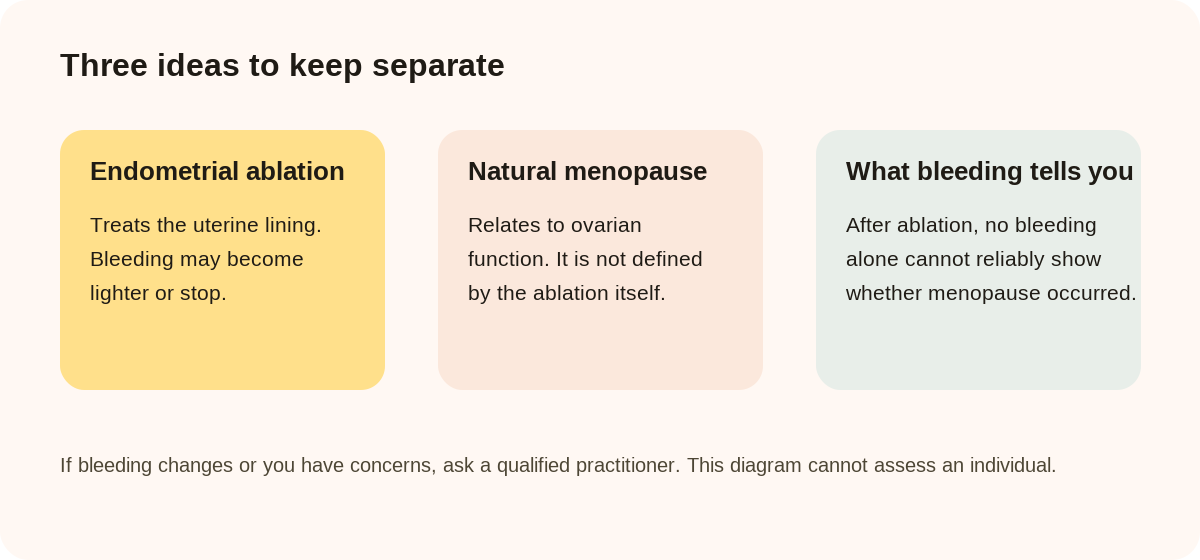
If you have had an endometrial ablation and your bleeding has become very light or stopped, you may wonder whether you have reached menopause. The short answer is that bleeding alone cannot reliably tell you. Ablation treats the lining inside the uterus. It can change or stop bleeding, while natural menopause is related to ovarian function. They are different processes, even though both can affect periods.
This distinction matters because people often use the last period as a marker of menopause. That marker becomes less useful after a procedure that deliberately changes the uterine lining. This article explains the difference and gives you a way to discuss uncertainty with a qualified practitioner. It cannot determine your personal menopause status or tell you whether a particular test is needed.
What endometrial ablation changes
Endometrial ablation is a treatment used for heavy menstrual bleeding. A clinician uses a device or energy to destroy or remove much of the endometrium, the lining of the uterus. The exact technique differs. It is not the same as removing the uterus, and it does not automatically remove the ovaries. The Cornwall Hospitals patient leaflet describes the treatment as permanently destroying the uterine lining.
After the procedure, some people continue to have periods, often lighter than before. Others have no bleeding. The outcome depends on the procedure and individual circumstances. A lack of bleeding after ablation may therefore reflect the effect on the lining rather than the ovaries having stopped their usual hormone activity. A bleeding pattern cannot show which of these explanations applies to you.
Keep the name and date of your procedure if you can. If you do not remember whether you had an ablation, hysterectomy, or another operation, do not try to infer it from the amount of bleeding. The operative note, discharge summary, or clinic letter may clarify what was performed. Our guide to checking an operation record after hysterectomy covers a related records question, but an ablation is a different procedure.
What natural menopause means
The World Health Organization defines natural menopause retrospectively: it has occurred after twelve consecutive months without menstruation when there is no other obvious physiological or pathological cause and no clinical intervention. This definition uses the final menstrual period as a marker in circumstances where bleeding is a meaningful signal. An intervention that changes uterine bleeding makes that signal harder to interpret.
Menopause reflects a change in ovarian follicular function and falling circulating oestrogen. It is not defined by a particular amount of bleeding from the uterus. Ablation acts on the uterine lining. The procedure itself is not proof that ovarian function has stopped, and continued or absent bleeding after it does not, by itself, establish whether the menopause transition is underway.
Why the last-bleeding-date rule may not fit
The familiar twelve-month rule assumes the absence of bleeding can be interpreted as the end of natural menstruation. After ablation, the procedure has already changed the tissue that sheds during a period. That means the same observation, no bleeding, may have more than one explanation. It is not possible to separate them from a calendar alone.
Likewise, spotting or occasional bleeding after ablation does not automatically settle the question. A return or change in bleeding can have several possible explanations, and this page does not diagnose them. If bleeding is new, persistent, heavy, painful, or worrying, arrange an assessment with a qualified practitioner. Do not assume every change is menopause or a routine effect of an old procedure.
Ablation is not hysterectomy
These terms describe different operations. Endometrial ablation treats the inside lining of the uterus while leaving the uterus in place. Hysterectomy removes the uterus. In a hysterectomy, the ovaries may be left in place or removed as part of a separate procedure. That difference matters because removing both ovaries before natural menopause causes an abrupt change in ovarian hormone production; removing the uterus alone does not necessarily do so.
After hysterectomy, there is no uterine bleeding to track. After ablation, the uterus remains, but bleeding may be reduced or absent. In both situations, period history may not give the same information it could otherwise provide, but for different reasons. Do not apply another person’s surgical experience to your own. The operation record is more useful than a broad label such as “womb surgery.”
If you are unsure what your operation included, request the operative note and discharge summary from the hospital or clinician who performed it. Ask for clarification of unfamiliar terms rather than guessing from an abbreviation. The existing health records organiser can help you keep copies and questions together. It is a navigation aid, not a record interpreter.
Symptoms and practitioner conversations
You do not need to prove that a symptom is caused by menopause before discussing it. A practitioner can consider your age, health history, operation, symptoms, and other possible explanations. The aim of the conversation is to understand what needs attention and what information would help, not to force every change into a menopause category.
Write down what has changed and when you noticed it. For bleeding, note whether it is absent, occasional, or has returned; for other concerns, record how often they occur and how they affect daily life. These notes are observations, not a score or diagnosis. Bring your procedure name and reports if available. If you have no records, say what you remember and what is uncertain.
You might ask: “Could the ablation explain why I do not bleed, and what can it not tell us about ovarian function?” “Does my procedure record show exactly what was done?” “Are my symptoms enough to discuss menopause, or should we consider other causes too?” “If you think an investigation is relevant, what question would it answer?” These questions invite an explanation without presuming the answer.
Guidance about using blood tests to identify menopause depends on age and clinical context. The useful general point is that decisions depend on context, and an individual result should be interpreted by a qualified practitioner. Avoid ordering or stopping anything based on this article.
If a practitioner suggests a test, ask what it is intended to clarify, whether the result could change the plan, and how it would be interpreted alongside your history. A test is not automatically useful simply because bleeding is hard to track. You can ask what uncertainties will remain even after testing. This keeps the discussion focused on a decision rather than collecting results without a clear purpose.
Fertility and contraception still matter
Endometrial ablation is not contraception. The Gloucestershire Hospitals leaflet says pregnancy can still occur and can be dangerous after the procedure. The hospital advises continuing contraception as before. If pregnancy is possible for you, ask a qualified practitioner about contraception that fits your health and circumstances. Do not use absent bleeding after ablation as proof that pregnancy cannot happen or that menopause has occurred.
This can feel counterintuitive when periods have stopped. But a procedure that changes uterine bleeding does not establish that ovulation has ceased. The practical separation is: the ablation may affect bleeding; menopause relates to ovarian function; contraception is a separate question. Each may need its own conversation. This article cannot determine fertility or recommend a contraceptive method.
If you think you may be pregnant or have urgent symptoms, seek local medical care promptly. Do not wait for a menopause appointment or an old procedure record to be located before addressing a time-sensitive concern. A practitioner can advise what assessment is appropriate. This is particularly important because pregnancy after ablation may carry serious risks, as patient information from Gloucestershire Hospitals and Royal Cornwall Hospitals cautions.
If you cannot get a clear answer
Start by asking for the records that describe the operation. If the hospital has changed names or does not hold the file locally, ask which department or archive manages older records. Keep your request dated and note the response. Your records may help explain the procedure but will not independently diagnose menopause.
At an appointment, separate three questions: what operation occurred, what might explain the bleeding pattern, and what you want help with now. A clinician may not be able to reconstruct every detail from memory or an incomplete file. It is reasonable to ask what is known, what remains uncertain, and whether the uncertainty changes your next step.
If the answer is “we cannot tell from bleeding alone,” ask what information would be useful and what symptoms or changes should prompt another conversation. You can also ask when to follow up if the issue persists. Keep the plan specific: who will contact whom, what record or result is expected, and when you should check back. These are practical navigation questions, not instructions to diagnose yourself.
If your immediate concern is bleeding after menopause, use our separate guide to bleeding after menopause and contact a qualified practitioner. If you are acutely unwell or believe you need urgent help, use local urgent medical services. A content page or record request should never delay urgent assessment.
Frequently asked questions
Can no periods after ablation prove I am menopausal?
No. Ablation can reduce or stop bleeding by treating the uterine lining. Natural menopause relates to ovarian function. Because the procedure changes the bleeding signal, absence of periods alone cannot reliably establish menopause after ablation.
Does endometrial ablation remove the ovaries?
No. Endometrial ablation treats the lining inside the uterus. It does not, by itself, mean that the ovaries were removed. If the operation name or paperwork is unclear, request the operative note and ask a qualified practitioner to explain it.
Can pregnancy still happen after ablation?
Yes, pregnancy may still be possible, and hospital patient information warns that pregnancy after ablation can be dangerous. Ablation is not contraception. Ask a qualified practitioner about contraception if pregnancy is possible for you.
Should I get a hormone blood test because I cannot track periods?
This article cannot decide whether you need a test. Guidance varies by age and context, and test results need professional interpretation. Ask what clinical question a proposed test would answer and whether the result would change your care.
Is ablation the same as having a hysterectomy?
No. Ablation treats the uterine lining and leaves the uterus in place. Hysterectomy removes the uterus. Whether ovaries are removed during a hysterectomy is a separate detail that should be checked in the operation record.
Should I seek help if bleeding returns after ablation?
If bleeding returns or changes and it is new, persistent, heavy, painful, or concerning to you, contact a qualified practitioner for an assessment. This page cannot identify the cause, and a change should not automatically be labelled menopause or a routine procedure effect.
Sources and further reading
This resource provides general information and does not diagnose a condition or replace advice from a qualified practitioner.