
On this page
If you are looking for a mammogram in India, it can be hard to tell whether you are asking about routine screening or an investigation for a change you have noticed. These are different questions. A mammogram is an imaging test that uses low-dose X-rays to create pictures of breast tissue. The Indian public-health module we reviewed describes community-level breast screening with a clinical breast examination (CBE), not a mammography schedule.
That distinction does not mean mammography is unavailable or never used in India. It means the public documents cited here describe one population programme, while a mammogram may be considered in other clinical pathways. Services and referral routes vary by location and facility. This page summarises the sources we checked; it does not recommend a screening test or decide what is appropriate for an individual.
Screening and symptom assessment are not the same
Screening refers to checking a group of people who do not have a known symptom, with the aim of identifying people who may need further evaluation. An abnormal screening finding is not a diagnosis. A diagnostic assessment investigates a symptom, examination finding, or prior test result. A practitioner may use examination, imaging, or another step depending on the concern and context.
The World Health Organization distinguishes early diagnosis of people with symptoms from screening people who do not have symptoms. Linking screening to timely diagnosis and treatment matters; a test on its own is not the whole pathway. This is why the practical question is not only “Which test is best?” It is also “What question is this visit trying to answer, and what happens if there is a finding?”
If you have noticed a new lump, nipple or skin change, unusual discharge, or a persistent change that concerns you, arrange assessment rather than waiting for a screening camp or a routine screening interval. The practitioner can decide what evaluation is appropriate. Our guide to breast pain in your 40s helps organise a symptom conversation, but it does not replace an assessment.
What a mammogram does
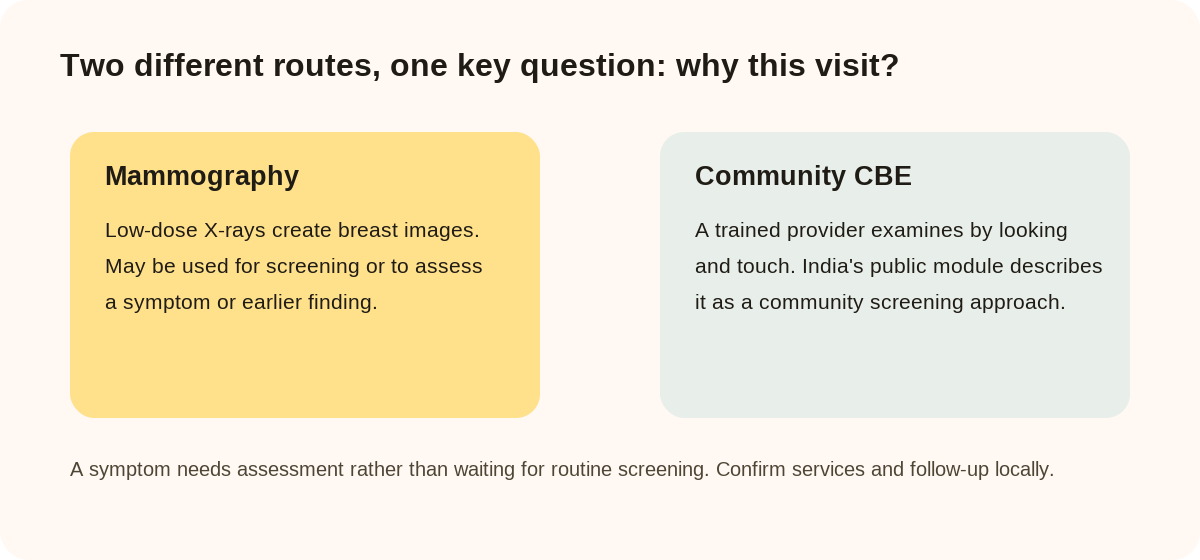
The National Cancer Institute describes mammography as an imaging test using low-dose X-rays to make pictures of the breasts. It can be used for screening when a person has no known symptom, or diagnostically when a symptom or earlier finding needs evaluation. The same type of machine may be used, but diagnostic imaging can involve additional views. The purpose and clinical context distinguish the two pathways.
An imaging report is not the same as a diagnosis or a complete care plan. A practitioner or radiologist interprets images alongside the reason for the test and relevant history. Sometimes a report recommends comparison with earlier images or additional assessment. That recommendation does not itself tell you what the result means; ask the ordering practitioner or imaging centre who will explain it and arrange any follow-up.
What India's public documents describe
The Ministry of Health and Family Welfare’s Module for Multi-Purpose Workers describes population-based breast screening for women aged 30 to 65 using a clinical breast examination at five-year intervals. The document is an operational training module, not a personal medical recommendation. It describes the work of community health staff and the programme framework. The material we reviewed does not set out a universal public mammography schedule for every woman in India.
That statement is deliberately limited to the document and public sources checked for this article. It is not proof that every state, hospital, private centre, or updated programme uses the same approach. Nor does it mean mammography is not available. Local facilities may have different services and referral protocols. Ask the centre what it currently offers and whether the visit is for population screening, symptom assessment, or follow-up of a prior finding.
The Ministry module describes CBE as one screening method and explains referral when an examination identifies a concern. A CBE and a mammogram are not interchangeable. A CBE is performed by a trained provider using observation and touch. Mammography creates X-ray images. Another test, such as ultrasound or biopsy, may be considered in a diagnostic pathway, but this article does not say which is right for a particular person.
The Health Technology Assessment in India policy brief published in March 2024 evaluated several screening strategies using an economic model. In that analysis, CBE every five years among people over 30 was the most cost-effective strategy among those studied. Cost-effectiveness modelling compares strategies under stated assumptions. It is not a clinical trial proving that one schedule is right for every individual, and it is not a national personal screening rule. The distinction between a model’s policy analysis and individual care is important.
Why schedules from other countries may not apply
You may find online advice that names a starting age, interval, or stopping age. Schedules are developed for specific health systems and should not be treated as automatic India-wide guidance. If a clinician recommends a schedule, you can ask which guideline or risk factors inform it and how the recommendation fits your circumstances.
Personal history can affect a discussion. Tell a practitioner if you have had breast cancer or another breast condition, breast surgery, prior radiation treatment, or a close family history of breast or ovarian cancer if known. This information does not determine a test by itself. It helps the practitioner ask more focused questions. If a relative’s diagnosis or age is uncertain, say so rather than trying to fill in the details.
Questions to ask before booking
Start by clarifying the purpose of the appointment. You might ask: “Is this routine screening or an investigation of a symptom?” “What test or examination will be done, and what question is it meant to answer?” “Is this the public programme’s CBE service, or an imaging appointment?” “If a finding needs more evaluation, who will contact me and where?”
If mammography is proposed, ask whether the appointment is a screening or diagnostic mammogram, whether previous images or reports would help, how and when results will be shared, and whom to contact if you do not hear back. Ask the imaging centre about practical preparation, accessibility, privacy, costs, and whether an appointment is required. These are service questions, not instructions about which test you should have.
If CBE is offered, ask who performs it, how privacy is maintained, what clothing needs to be removed, and whether each step can be explained before it begins. You may ask for a pause or clarification. Local arrangements for female staff, chaperones, and support people vary. Confirm what is available at the specific facility rather than relying on a general description.
Bring previous reports if available. Note the date and reason for past tests, any current change, and what you hope to clarify. The appointment preparation guide offers a place to organise questions. If you have a report and need to keep it with other records, the health records organiser can help. These resources support preparation and record keeping; they do not interpret results.
If a result needs follow-up
Ask for the next step in plain language and in writing if possible. What finding needs review? Which facility or practitioner should you contact? Is there a referral letter? Who is responsible for arranging the next appointment? When should you expect to hear back, and whom should you contact if there is no update? Write down the contact name or desk and keep a copy of each report.
An abnormal screening result does not establish cancer. It signals that further evaluation may be needed. The Ministry module describes referral from community screening for additional investigation. The precise route may differ by state and facility. If the referral seems unclear, ask the health worker to explain the destination and how you will receive the result.
A normal result also has limits. If a new symptom appears later, discuss that symptom rather than waiting for the next routine interval. A screening encounter is not a promise that no future assessment will be needed. If you feel acutely unwell or believe the situation is urgent, use local urgent medical care rather than waiting for a routine screening appointment.
A note on evidence and uncertainty
Health programme documents can be older than the service currently available in a particular district. The Ministry operational module describes a community process. The 2024 HTA policy brief models economic value among selected strategies. WHO describes the broader distinction between screening and early diagnosis. The National Cancer Institute explains what mammography is and how screening and diagnostic imaging differ.
No source here establishes an India-wide mammogram interval for every individual. If a new protocol is issued or a facility’s services change, the practical answer may change. Ask the specific public centre, hospital, or practitioner what protocol they follow today.
The separate guide to clinical breast examination in India explains what that community examination may involve and what it cannot tell you. This page focuses on how mammography differs, what the sources say about the public screening framework, and how to clarify the purpose and follow-up of a specific appointment.
Frequently asked questions
Does India have one routine mammogram age for everyone?
The public sources checked here describe community breast screening by clinical breast examination, not one universal mammography schedule for every person. This is a bounded finding, not proof that mammography is unavailable. Ask the local facility or practitioner which current protocol applies.
Is a mammogram the same as a clinical breast examination?
No. A mammogram uses low-dose X-rays to make images of breast tissue. A clinical breast examination is performed by a trained provider using observation and touch. They are different methods and are not interchangeable.
Does an abnormal screening result mean I have cancer?
No. A screening finding may need further assessment, but it is not a diagnosis by itself. Ask who will explain the finding, where follow-up will happen, and how you will receive any further results.
Should I wait for screening if I have noticed a breast change?
No. A new lump, skin or nipple change, unusual discharge, or persistent concern should be discussed with a qualified practitioner rather than waiting for a routine screening appointment. This article cannot choose the investigation for you.
Does the 2024 cost-effectiveness report set my screening schedule?
No. It is an economic model comparing selected strategies under assumptions. Its conclusion about CBE intervals is not a personalised recommendation or proof that the same schedule is suitable for every individual.
What should I ask if mammography is recommended?
Ask whether it is for screening or a symptom, what question it is meant to answer, whether earlier images are useful, when results will arrive, and who will explain them. These questions clarify the process without substituting for a practitioner’s advice.
Sources and further reading
- Ministry of Health and Family Welfare, Module for Multi-Purpose Workers on Prevention, Screening and Control of Common NCDs, 2016
- Health Technology Assessment in India, Health Technology Assessment of Strategies for Breast Cancer Screening in India, policy brief, 7 March 2024
- World Health Organization, Breast cancer fact sheet, 3 July 2026
- National Cancer Institute, Mammograms
This resource provides general information and does not diagnose a condition or replace advice from a qualified practitioner.